

Forklift Dealership Marketing: Why Expanding Your Product Line Won’t Work—Unless You Do This
For years, forklift dealerships had one job: sell and service forklifts. Success came from...
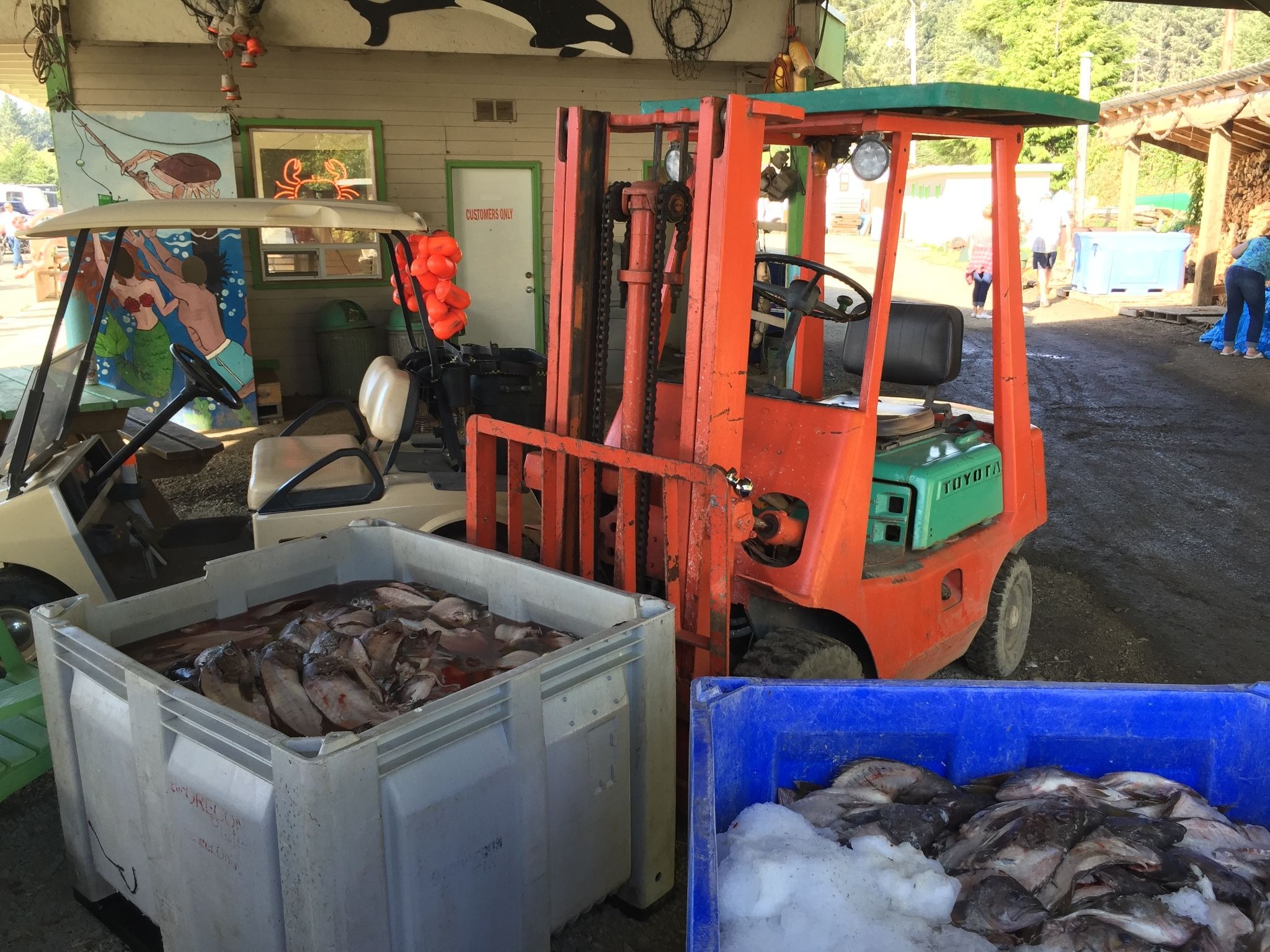
This week's forklift was spotted at a crab marina, lifting a tote full of fresh catch. Proof that wherever there's a load to move, a forklift will find it.
Last week, forklift marketing managers received two messages from OEMs, and they point in opposite directions.
One OEM warned its dealers about branded AI-generated images. That same Thursday afternoon, a different OEM was running a session that teaches dealers how to make AI images with its brand.
Neither one is wrong. Protecting the brand is a real job. So is getting the brand seen. But if you're a forklift dealership marketing manager with both emails sitting in your inbox, you'd be forgiven for feeling like a kid with two parents and two different curfews.
My advice is boring: know what your dealer agreement says. The rules are different at every OEM, and "the other brand lets their dealers do it" has never once won that argument.
Stay tuned for another episode of AI Accelerationists vs. AI Doomers: The OEM Battle to Control How Dealers Use AI.
You know the one. So cool. So much potential. And it's been sitting on your line card for two years without saying a word.
Sometimes it comes up in meetings. Everyone agrees: we should sell more of this. Then your team goes right back to avoiding it like a cold call on a Friday.
I have a theory about these neglected orphans. Think of a neglected product like a forklift that just came off lease.
You'd never put it up for resale as-is. You'd send it to the used equipment bay for reconditioning. Your orphan product needs the same trip. Only here, nothing mechanical gets touched. The reconditioning is on the words.
Picture it. The spec sheet goes in, your team does their magic, and out comes business outcomes customers care about.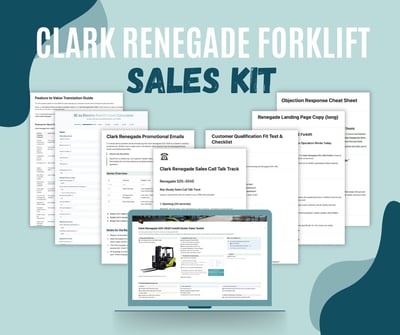
A list of product talk tracks: the benefits, the value of the product, and copy scripts that speak to what keeps them up at night. Language your customers eat up: fewer damaged racks, faster picks, one less operator complaint.
Every dealership has a reconditioning bay for equipment. It makes the forklift look better. Product marketing is the bay for words. It makes the product sound better to customers. Almost no dealership has one. The launch deck goes straight from the OEM portal to your reps, acronyms and all.
Look at the premium brands, the ones that can't win on price. They have a whole product marketing team. Engineers build the product, and they do their job well. Product marketers translate it into reasons a customer should care, because a premium brand knows its channel partners have to sell the solution, not the steel.
Most OEMs send you the basics:
That gets your reps to the starting line. But those materials are written for every dealer in the country, and they stop at what the product is.
Who creates the sales copy that tells the story? Your reps need that tool in their hands: what the product does for your customers, in your customers' words, ready to grab before a call. As an outside consultant working with several dealers, almost everyone skips this step.
Here's what that costs you.
Reps avoid products they can't explain confidently. Not because they're lazy. Because standing in front of a customer without the words is a bad feeling, and humans route around bad feelings. The products your team "just doesn't push" are almost always the products nobody translated.
I learned this one the hard way. I spent weeks asking a sales team for telematics success stories. I wasn't asking for much. I needed examples. Stories. Something about how telematics helped a customer who cut an underutilized truck from the fleet.
Or maybe a story about a warehouse that noticed all its pallet strikes were happening in the same lane. The telematics helped them know they needed to , add a mirror, floor tape, and coaching for the three operators the data flagged. Anything. The answer I finally got was "the OEM has a white paper. Get it from there."
I read the white paper.
More specs.
I dug through the OEM portal.
All specs.
That was the moment I understood the real problem. The reps weren't holding out on me. They didn't understand the product well enough to have stories about it. Nobody had translated it for them, so they never brought it up with customers, so the stories never got a chance to exist.
The translation I needed didn't exist anywhere. So I went through the process myself and built a product marketing kit for the telematics product.
You may know the 5 Whys from the lean world, where it's used to chase down the root cause of a problem. I use a quick version of it to chase down the reason a customer should care.
I call it the Where there's a why, there's a buy framework.
Take one feature and keep asking why it matters until the answer sounds like something your customer worries about.
Here's one chain straight from a telematics product:
The feature: It has impact sensors.
Why does that matter? It logs every pallet strike and rack hit.
Why does that matter? Damage stops being anonymous. The forklift won't start without an operator's badge, so every impact has a name on it.
Why does that matter? Operators are more careful when they know they're accountable.
Why does that matter? When a hit happens, you have the details and you know exactly who needs coaching. No lineup, no guessing.
Why does that matter? The damaged rack gets reported and fixed now, not discovered during a safety audit six months later. Your warehouse is safer and the repair is cheaper.
Look at where that chain starts and where it ends. "It has impact sensors" is an engineer's sentence. "No more anonymous rack damage" is a warehouse manager's sentence. Most reps are out there saying the first one, because nobody ever walked the chain with them to the last one.
Engineers speak specs. Customers speak outcomes.
Here's the good news. If you had the time, you could do this yourself. Your team already knows what customers care about.
👇 Here's how to do your own product marketing.
➡ Pick your orphan product. You know the one.
➡ Grab one line off its spec sheet.
➡ Ask yourself: "Why would a customer care about this?"
➡ Your first answer will describe the product. Push once more: "OK, so what does that do for their operation?"
➡ You're done when the answer names something a customer loses sleep over. Less downtime. Fewer damaged pallets. An aisle they couldn't turn in before.
➡ Circle the last thing on the list. That's what your reps should be saying, and as of right now it doesn't exist anywhere at your dealership.
➡ Use AI to help. (If your OEM agreement allows it.)
Ten minutes, one product, and you end up with a sentence a rep can use this week.
Next level: if you want to go further with this, convert all of the product's features into business outcomes, then do the same for the rest of your line. Put the answers in one document your whole sales team pulls from.
Now your reps walk into every call carrying a list of reasons customers buy instead of a spec sheet. New reps ramp faster, veteran reps stop winging it, and the products your team "just doesn't push" start showing up in quotes. If you've ever wondered why one rep sells a product and the other five don't, this document is usually the difference.
Let's be honest. If you had the time to do this, you would have done it already. And if you don't have the time, this is my jam. I made a product marketing kit when Clark launched their new Renegade forklift. Even if you don’t sell Clark, check it out as an example of what’s possible
So, what do you think of my theory? What's your orphan product? Every dealership has one. And do you think a round of product marketing would get it moving? Send me a message or reply and tell me.
Stay Visible,
Julie
P.S. If your OEM sends you a third opinion on AI this week, forward it. I'm keeping a collection.
